IT'S CHOCOLATE MONTH


Thursday, February 25, 2016

Coal = DIAMAAAAAANDS


No, diamonds are NOT made of coal. Forming coal is a multi-million year process, the oldest specimens tracked back to 300 to 400 million years ago. Diamonds, however have been found to have been made 1–3 billion years ago. Besides this time difference, there is another reason why diamonds aren't made from coal. Diamonds come from a pure element - carbon. Yes it's true that coal is made mostly of carbon, but "mostly" doesn't cut it! Because it is made of multiple elements, coal has many impurities. Impurities are the enemy of a nice, clean, sharp, diamond. This means that "at the most can change its chemical composition and transform into its nearly purest form which is Graphite but not diamond. The conversion of coal into diamond is almost impossible due to its impurities" (todayifoundout.com). IN ADDITION, the pressure needed for diamonds to form is found only 87 to 120 miles deep into the Earth's crust. Coal is rarely ever found deeper than 2 miles, so in other words:
Are diamonds made of coal?

no minions
Verdict: FALSE

Thursday, February 18, 2016

Flushed away


 Okay, so a belief is held that a toilet will flush water counter-clockwise in the Southern Hemisphere, and clockwise in the Northern Hemisphere. This is then often attributed to the Coriolis effect and said to be completely verified and backed up by videos online of American and Australian toilets flushing in different directions. However, this is a great misconception. The Coriolis effect* can't actually be the reason for this though. It doesn't make sense because  "toilets—and even tornadoes—are too small to be affected by the Coriolis, whose force would only begin to directly influence a storm's swirling mass if it were approximately three times larger than the supercell storm systems that typically generate tornadoes" (www.scientificamerican.com). So why the change? Well, I can't be sure of the origin of this myth. However, the reason toilets flush in different directions could be due to the manufacturers.


*The Coriolis effect is "an apparent force which describes how objects veer to the left or right when traveling on something that’s rotating" (www.sciencegeekgirl.com).


Friday, February 12, 2016

Could a T-rex see YOU?


In dinosaur movies like "Jurassic Park", there is a recurring idea for a scene. To avoid being spotted when the monster comes near, you MUST. STAY. STILL. But would this really work with a T-Rex? Is a T-Rex' eyesight, REALLY that bad?
Well;
"The T-Rex may well have had visual clarity up to 13 times better than a modern human. For reference, an eagle has about 3.6 times the visual clarity of a person. Additionally, it was determined that a T-Rex’s vision allowed an object to remain relatively clear up to six kilometers away. For humans, it’s only about 1.6 kilometers for the same clarity. As [Professor Kent Stevens] put it, “With the size of its eyeballs, (the T-Rex) couldn’t help but have excellent vision”"
(todayifoundout.com).

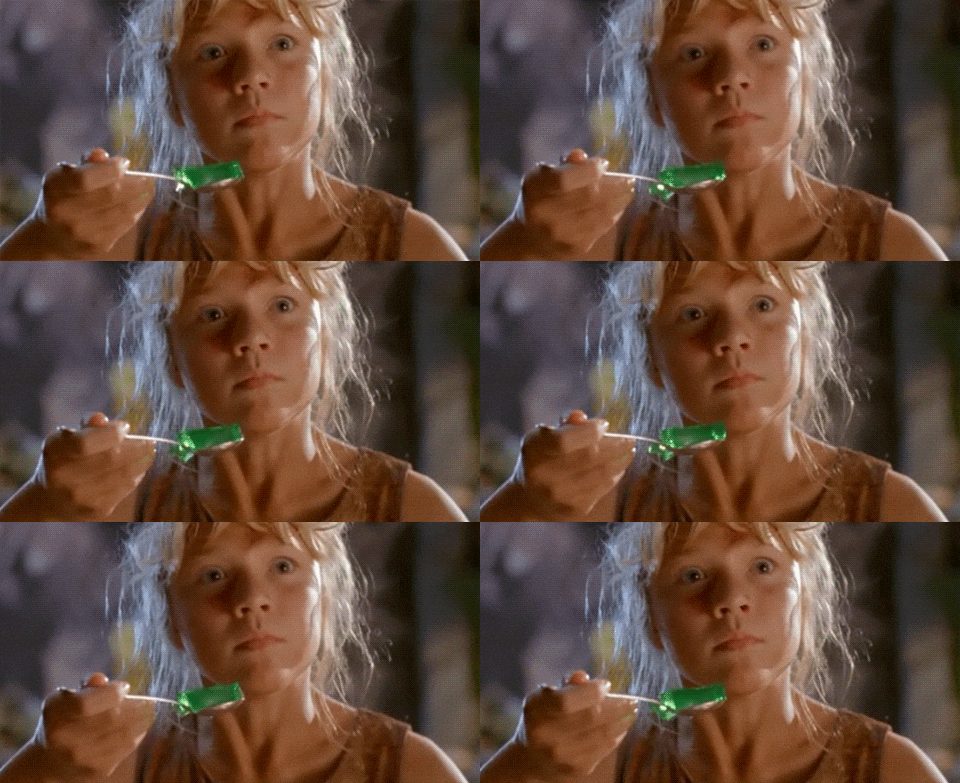
So... a T-Rex has really good eyesight. Like, ridiculously good. And, even if they didn't have the best eyesight, this myth is still on shaky ground. The T-Rex were predators, and if they could really be stumped just by standing still... I mean, come on! Besides, people can't stand completely still. I mean just look at the gif. If you were to confront a dinosaur, there is no way you wouldn't be at least somewhat jittery! So, I mean, in any case:

Verdict: FALSE

Wednesday, February 3, 2016

Sugar Happy!


Lollipops, chocolate, cake, and more sugary delights: a little kid's favorite snacks... And a parent's headache. They worry that their kids will get a sugar rush, and be hyper. But is this true at all? Nope. I mean, it might cause a shorter attention span according to a study conducted by a Dr. Wesnes, but not hyperactivity. In fact, "through various experiments over the years, scientists have discovered that no substantial evidence exists to support the claim that sugar causes hyperactivity" (http://www.yalescientific.org).

So why did people start believing this? I can see why a parent might make this connection. I LOVE candy and sugar, whenever I see a see a sweet, sugary concoction being presented before me, I get really happy like:
happy joy kermit best day ever stoked
So maybe parents made this connection based on kids' reaction to sweets? Or maybe its an excuse not to indulge kids with late night snacks? Either way, once eaten, the sugary sweets can't physically cause hyperactivity. Do with this info as you will. I'm gonna go eat a honey bun. And a cheesecake slice. And maybe a chocolate bar.

Verdict: FALSE

Friday, January 29, 2016

Humans only use 10% of their brains


 This is a misconception that EVERYONE has heard of. Is it true? Nope. Not at all. In fact, some neurologists laugh even at just the thought of it.
So what is the truth? 20%? 50%? 75%?
Well, according to neurologist Barry Gordon from Johns Hopkins School of Medicine in Baltimore, "It turns out though, that we use virtually every part of the brain, and that [most of] the brain is active almost all the time". So really, throughout the day, humans use most of our brains most of the time. An exact percentage varies a bit

Thursday, January 21, 2016

Tongue Taste Twist


Here's one you've probably heard before. People around the world believe that the tongue has certain areas that are used to identify different tastes. But, they are wrong. The TRUTH is that all areas of the tongue can more or less sense the different tastes equally. In fact, other areas of the mouth can too, like the back of the roof of your mouth. Why? Because these areas have taste receptors. But why did people ever think this was true? It all started with a scientist from Germany, D.P. Hanig. Hanig used a large group of people to see what areas of the tongue are more sensitive to what tastes. then, another scientist named Virginia Collings took Hanig's findings and converted the sensitivity ratings into numerical

Thursday, January 14, 2016

Food isn't dirty if it has been on the floor for 5 seconds or less.


Otherwise known as the "Five Second Rule", this myth has been circling English speaking countries for decades. 
But is it true? 
Does it even make sense? 
Actually, how do I put this, 

 Logically, this idea is absolutely false, a lie, NOT TRUE whatsoever. The moment food hits the ground, bacteria or "germs" as shown in the first image don't wait for 5 seconds. Why would they? Of course, there are variables. For example, food falling on the floor of a public restroom will likely pick up more than maybe if it fell on the floor of your bedroom or a hospital. Then there's also the food itself. If it is wet, it will pick up more bacteria than something dry like a cracker. Plus, not all bacteria is "bad". In fact, some bacteria exist inside you to help with digestion and to fight the "bad" bacteria. Even so, you have no way of knowing whether the bacteria the food comes into contact with is "good" or "bad" unless you are a Mythbuster (or scientist) and have access to equipment to check. So why risk it? It isn't worth getting sick for, just find a replacement for that slice of pizza (or whatever fell) and eat "bad" germ free.
By the way, the Mythbusters actually busted this myth themselves as a mini-myth. Wanna see their results? 
Click here and enjoy!
Verdict: FALSE